


A finished manuscript can feel like the end of the hard part.
Then reality taps the author on the shoulder.
The file is ready, but the book is not. There is editing to confirm, a cover to design, formatting to prepare, ISBN details to understand, distribution options to compare, and a launch plan to think through. That is where Book Publishing starts to feel less like one task and more like a long hallway with too many doors.
For a first-time author, that can be both exciting and a little unfair. The story may be strong, but the publishing process still has to turn it into something readers can find, buy, open, and trust.
Stephen King once wrote, "Books are a uniquely portable magic." That magic still needs structure before it reaches readers.
• Professional publishing services usually cover far more than printing or uploading a file.
• First-time authors should understand editing, design, formatting, ISBN setup, distribution, and marketing before choosing support.
• A good publishing plan starts with the condition of the manuscript, not with a package name.
• The best checklist helps authors avoid paying for services they do not understand.
Professional book publishing services usually include manuscript review, editing, cover design, interior formatting, ISBN guidance, publishing setup, distribution support, and launch preparation. Some providers may also help with ghostwriting, printing, author websites, book marketing, audiobooks, and promotional materials.
The simple version is this: publishing support helps turn a manuscript into a reader-ready book.
That does not mean every author needs the same services. A memoir writer with a polished draft may need editing, cover design, formatting, and publishing setup. A business owner with only an idea may need book writing support before publishing even begins. A children's book author may need illustrations, layout, print preparation, and guidance on age-appropriate presentation.
A helpful publishing process should answer three questions early:
1. What does the manuscript need right now?
2. What should happen before publication?
3. What can wait until after the book is live?
That clarity matters because publishing is not just about getting a file online. It is about preparing the book so it can stand beside other professional titles in its category.
Uploading a book is a technical step. Publishing is the full preparation process that makes the book readable, sellable, searchable, and credible.
Think of it like opening a small café. A person can cook something delicious and open the door, but that does not mean the menu is clear, the space feels welcoming, the sign is visible, or customers know why they should walk in.
Books work the same way.
A manuscript may be meaningful, but it still needs structure around it. That structure often includes:
• editing for clarity and flow
• proofreading for final errors
• cover design that fits the genre
• interior formatting for print and ebook
• ISBN and metadata guidance
• distribution setup
• book description and author bio support
• launch and marketing preparation
This is especially important because the book market is crowded. According to Publishers Weekly reporting on Bowker data, self-published titles with ISBNs rose 7.2% in 2023 and topped 2.6 million titles.
That number should not scare authors. It should sharpen the point.
A book does not only need to exist. It needs to look prepared.
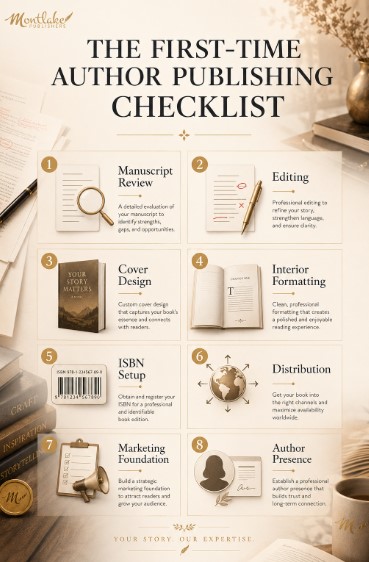
Before choosing a publishing path, first-time authors should walk through this checklist.
1. Manuscript stage: Is the book complete, unfinished, or still an idea?
2. Editing level: Does it need developmental editing, line editing, copyediting, or proofreading?
3. Cover direction: Does the design match the book's genre and reader expectations?
4. Interior format: Will it be published as an ebook, paperback, hardcover, or multiple formats?
5. ISBN and metadata: Who handles identifiers, categories, title information, and book description?
6. Distribution route: Where should the book be available?
7. Marketing foundation: How will readers discover and understand the book?
8. Author presence: Does the author need a website, bio, media kit, or platform support?
This checklist changes the conversation.
Instead of asking, "Can someone publish my book?" the better question becomes, "Which parts of the publishing process does this book actually need?"
That one shift can save a first-time author from confusion, rushed decisions, and weak presentation.
Editing is usually the first major step because every other service depends on the manuscript being ready.
A cover cannot fix a confusing book. Formatting cannot repair weak structure. Marketing cannot save a manuscript that loses the reader halfway through chapter two.
Different types of book editing solve different problems.
| Editing Type | What It Fixes | Best For |
|---|---|---|
| Developmental editing | Structure, argument, pacing, chapter order, story logic, character arc | Early or uneven drafts |
| Line editing | Sentence flow, clarity, tone, rhythm, readability | Complete drafts that need polish |
| Copyediting | Grammar, punctuation, consistency, usage, word choice | Near-final manuscripts |
| Proofreading | Typos, small errors, final formatting checks | Books almost ready for publication |
The common mistake is treating proofreading like a magic wand.
Proofreading is the final check. It is not meant to rebuild a chapter, repair a weak argument, or make the opening more compelling. If the book has deeper issues, proofreading will only tidy the surface.
A first-time author should ask for an honest recommendation on editing level before paying for final publishing steps.
Cover design is not decoration. It is reader communication.
A reader often sees the cover before the title description, the sample pages, or the author bio. The cover tells them what kind of book this is, what mood to expect, and whether it feels professional enough to trust.
A strong book cover design should fit the genre. A business book, thriller, memoir, romance novel, poetry collection, and children's book all use different visual signals. The goal is not simply to create something attractive. The goal is to make the right reader pause.
Interior formatting is the reading experience inside the book.
It includes:
• Chapter Title Styling
• Margins And Spacing
• Page Numbers
• Paragraph Layout
• Fonts
• Image Placement
• Trim Size
• Ebook Flow
• Print File Preparation
A document file may look fine on a laptop, then fall apart when converted into an ebook or prepared for print. That is why formatting is part of professional publishing, not an optional afterthought.
ISBNs matter because they help identify a book and support sales through major book channels.
The U.S. ISBN Agency explains that Bowker is the official source for ISBNs in the United States, and that an ISBN helps identify a book while supporting sales to bookstores, online retailers, and libraries.
In plain language, an ISBN helps the book behave like a real product in the publishing supply chain.
A paperback, hardcover, ebook, and audiobook may each require different setup decisions depending on the publishing route. Authors should ask who manages the ISBN, who owns it, and how it connects to the author or publisher account.
Distribution is separate but connected.
Distribution decides where the book can be available. That may include online retailers, print-on-demand networks, ebook platforms, bookstore databases, or direct sales through an author website.
Professional book publishing services should help authors understand the difference between availability and discoverability.
A book can be available online and still be hard to find.
Publishing prepares the book. Marketing helps readers notice it.
Many first-time authors think about marketing too late. The book goes live, then the author asks, "Now how do I get people to buy it?"
That order creates stress.
A better plan starts before launch. Professional book marketing may include book description support, audience research, author bio improvement, launch messaging, social content ideas, review planning, promotional assets, and reader outreach strategy.
Not every author needs a large campaign. But every author needs a clear answer to these questions:
• Who is this book for?
• Why should that reader care?
• What promise does the book make?
• Where will readers first discover it?
• What should they do after seeing it?
If those answers are vague, marketing becomes noise.
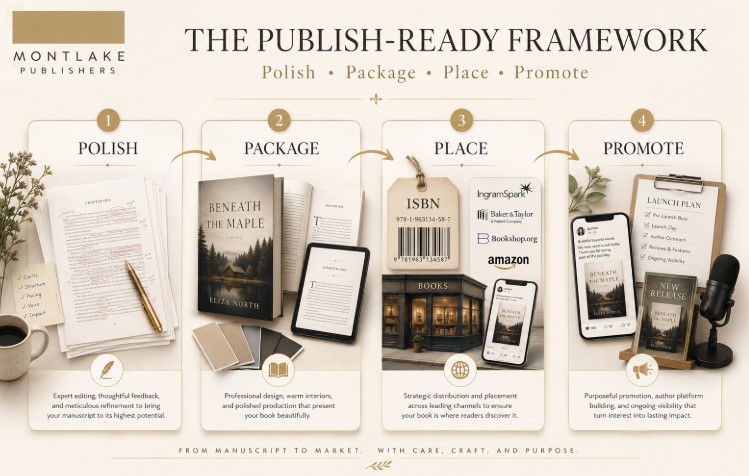
A first-time author can understand professional publishing with a simple four-part framework.
Polish. Package. Place. Promote.
Polish means preparing the manuscript through the right level of editing.
Package means cover design, formatting, book description, author bio, metadata, and reader-facing presentation.
Place means ISBN guidance, publishing setup, distribution route, and format decisions.
Promote means launch preparation, visibility planning, author website support, and marketing assets.
This framework keeps the process clean. If a book is not polished, packaging will not hide it. If it is packaged poorly, placement will not make it look trustworthy. If it is placed without promotion, readers may never find it.
All four pieces work together.
The biggest publishing mistake is rushing to the final step.
Authors sometimes want the book uploaded as quickly as possible because the writing took so long. That feeling is understandable. After months or years of work, waiting feels painful.
But rushing can create problems that stay with the book.
Here is the practical version.
Do this: Start with a manuscript review.
Not that: Assume the draft only needs a quick proofread.
Do this: Choose cover design based on genre and reader expectations.
Not that: Choose a cover only because it looks nice.
Do this: Ask who owns final files, ISBNs, and publishing accounts.
Not that: Assume every company handles rights and access the same way.
Do this: Plan basic marketing before launch.
Not that: Wait until the book is live and hope readers appear.
Do this: Ask what each service produces.
Not that: Buy the biggest package because it sounds complete.
A professional publishing conversation should make authors feel more informed, not rushed.
Picture an author with a completed memoir.
The story is heartfelt. Family members have read it and cried. The author feels ready to publish, so they skip deeper editing and focus on getting the book live quickly.
The result? The cover feels homemade. The opening chapter takes too long to settle. The description summarizes the story but does not make readers curious. The formatting has uneven spacing. There is no launch plan.
The story is still meaningful, but the book does not look ready.
A stronger path would begin with manuscript review, then editing, cover direction, formatting, ISBN guidance, distribution setup, and basic marketing preparation. That process does not make the story less personal. It gives the story a better chance to be taken seriously.
The right publishing support should fit the book's stage, genre, goals, and budget.
A first-time author should ask direct questions before starting:
1. What services are included?
2. What editing level does the manuscript need?
3. Who owns the final files?
4. Who manages ISBN registration?
5. Where will the book be distributed?
6. Will print and ebook formatting both be included?
7. Is marketing part of the service or separate?
8. What happens after publication?
The answers matter more than the package name.
Some authors need full author publishing services. Others need only editing and design. A children's book author may need book illustration, layout, and print guidance. A business author may need positioning, author website copy, and launch messaging.
A good provider should help the author understand the next right step, not push every service at once.
Professional publishing support is most useful when an author wants the book to look, read, and feel ready for real readers.
That may mean turning an idea into a manuscript through writing support. It may mean improving a draft through editing. It may mean designing a cover, preparing files, setting up distribution, planning book marketing, or building an author website that gives the book a stronger home online.
The point is not to make every book follow the same path.
The point is to build the path around the book.
Professional publishing services should not feel like a mystery box.
At their best, they turn a confusing process into a clear sequence: polish the manuscript, package the book properly, place it in the right channels, and promote it with intention.
A first-time author does not need to master every technical detail alone. But they should understand the major pieces before choosing help: editing, cover design, formatting, ISBN registration, distribution, book marketing, and long-term author presentation.
Book Publishing is not only about getting a manuscript online. It is about preparing the book so readers can trust it when they find it.
If the manuscript is ready, close to ready, or still sitting quietly in a folder, the next smart step is not rushing. It is finding out what the book truly needs before it meets the world.

If the book is ready, half-ready, or still waiting for the right next step, expert guidance can make the process clearer. Montlake Publishers helps authors understand what their book needs before launch, from manuscript preparation to publishing support. Call (737) 219-0010 or email [email protected] to discuss the project.
Professional book publishing services usually include editing, cover design, formatting, ISBN guidance, publishing setup, distribution support, and launch preparation. Some services may also include writing help, printing, author websites, book marketing, audiobooks, or promotional assets.
Book Publishing is the full process of preparing and releasing a book, while self-publishing is one possible route. Many self-published authors still hire professional help for editing, design, formatting, ISBN guidance, distribution, and marketing support.
First-time authors do not always need a book publishing company, but many benefit from guided support. Publishing decisions around editing, design, ISBNs, formatting, distribution, and launch planning can be difficult to handle alone.
An author should review the manuscript, choose the right editing level, define the target reader, prepare a professional cover, format the interior, understand ISBN needs, and plan distribution. Marketing should begin before the book goes live.
Manuscript publishing means taking a completed or nearly completed manuscript and preparing it for release. This may include editing, proofreading, cover design, formatting, ISBN setup, distribution, printing, and marketing preparation.
ISBN guidance and book distribution support may be included, but authors should confirm the details before starting. It is important to ask who owns the ISBN, who manages the setup, and where the book will be available.
Yes, some publishing services can help when the book is only an idea. In that case, the author may need writing, ghostwriting, outlining, or manuscript development before editing, design, and publishing setup begin.
The timeline depends on manuscript length, editing needs, design requirements, formatting, author revisions, and publishing goals. A polished manuscript may move faster, while a book that needs writing, heavy editing, or illustration usually takes longer.
Professional publishing support helps first-time authors understand what their manuscript needs before launch. It can reduce confusion around editing, cover design, formatting, ISBNs, distribution, marketing, and the steps that make a book look professional.
An author can request publishing support by sharing the book idea, manuscript stage, genre, and goals. From there, the right next step may be writing support, editing, design, publishing setup, or a broader launch plan.


5900 Balcones Dr, Austin, TX 78731, USA

