

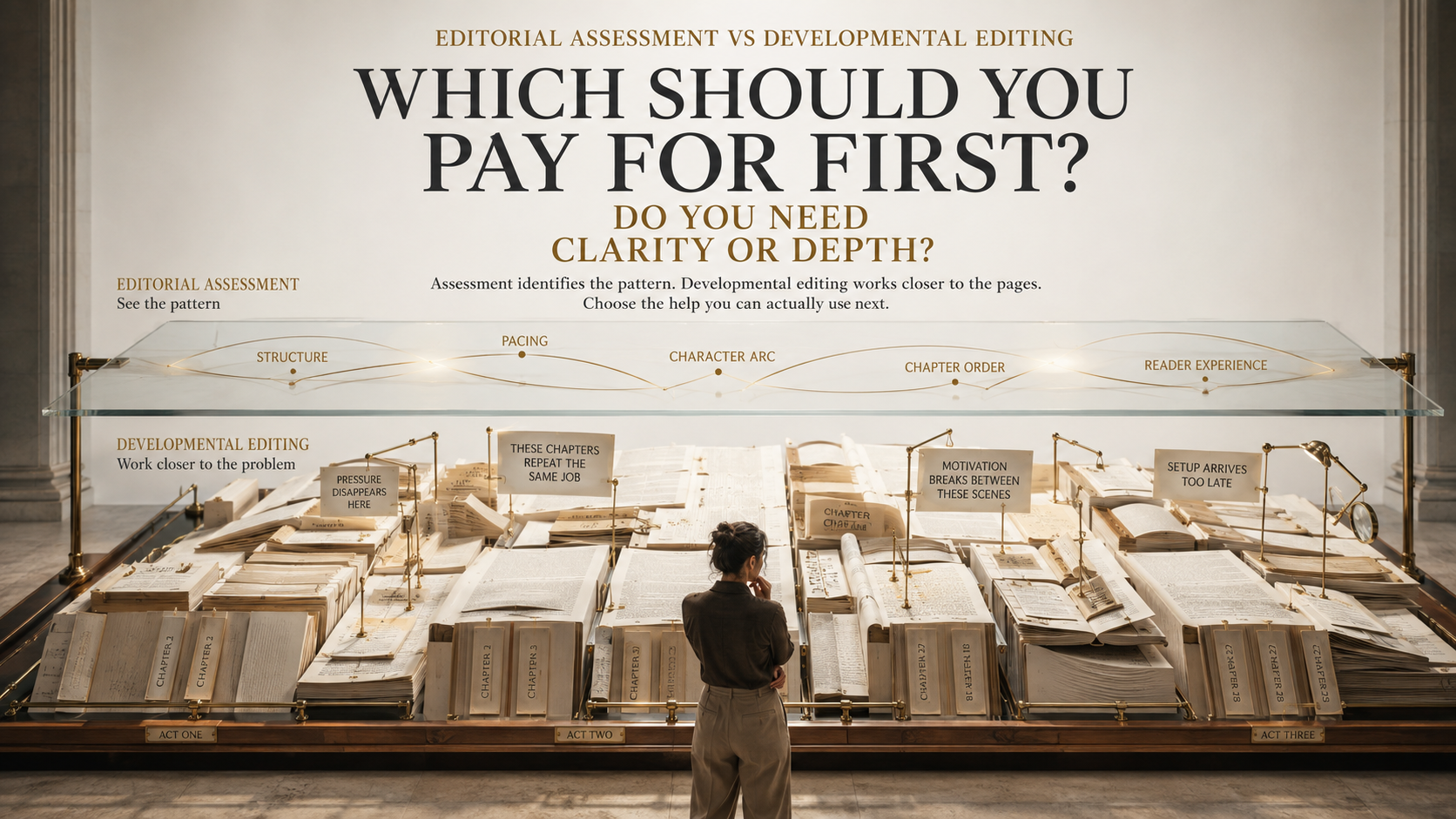
Editorial Assessment vs Developmental Editing: Which Should You Pay for First?
Paying for the wrong edit hurts twice.
First, you spend money on feedback your manuscript was not ready to use. Then you discover the book still needs the work you should have paid for in the first place.
That is the real problem behind editorial assessment vs developmental editing. Both can look at your book’s structure, pacing, characters, organization, and overall reader experience. But they give you very different levels of help.
Here is the shortest useful answer:
Choose an editorial assessment first when you need to understand what is wrong and you are comfortable doing the revision yourself. Choose developmental editing first when you already know the manuscript needs significant structural work but need an editor to show you, inside the draft, where and how to tackle it.
There is also a third possibility authors often overlook: your manuscript may be ready for neither.
If the structure already works and the real problem is prose, grammar, consistency, or final errors, you may be further along in the editing process than you think.
That is why Montlake Publishers approaches editing around the condition of the manuscript rather than assuming every author needs the largest editorial package.
Key Takeaways
Start with an editorial assessment when you need professional clarity, priorities, and a revision roadmap.
Choose developmental editing when you need detailed, manuscript-specific guidance to carry out structural changes.
Do not pay for both automatically. A strong assessment followed by serious self-revision may change what the manuscript needs next.
Compare deliverables, not service names. Editors do not all use editorial terminology in exactly the same way.
Do structural work before sentence-level polish. There is little value in perfecting a chapter that may later be cut, rewritten, or moved.
Editorial Assessment vs Developmental Editing: What Is the Real Difference?
The simplest difference is not “light editing versus heavy editing.” It is the distance between the feedback and your manuscript. An editorial assessment steps back and shows you the important patterns. Developmental editing comes closer, connecting those structural problems to specific chapters, scenes, arguments, transitions, or passages so you have more help carrying out the revision.
Both belong in the big-picture part of the editing process.
The current Editorial Freelancers Association editorial service definitions describe developmental editors as working with content, organization, and genre considerations. The EFA also notes that this work may involve an overall manuscript evaluation or a more detailed editorial letter with recommendations.
That overlap explains why authors encounter so many different labels:
editorial assessment
manuscript assessment
manuscript evaluation
manuscript critique
structural editing
substantive editing
content editing
developmental editing
Do not assume two editors mean exactly the same thing because they use the same label.
Read what the service actually includes.
What Does an Editorial Assessment Actually Give You?
Think about the moment when you know something is wrong with the book, but every time you reopen the manuscript, you end up changing sentences instead of solving the real problem.
That is assessment territory.
An editorial assessment gives you an experienced outside view of the manuscript as a whole. Instead of marking every page, the editor identifies recurring strengths, weaknesses, and revision priorities.
You may receive feedback about:
For Fiction
Plot and Structure
Does the story build logically? Are important events happening in the right order? Does the middle lose momentum? Does the ending earn its payoff?
Character Development
Do motivations make sense? Are character arcs visible? Does the protagonist actively drive the story, or mostly react to events?
Pacing and Tension
Where does the manuscript slow down? Which scenes repeat information or emotional beats? Where does the story move too quickly?
Point of View and Reader Experience
Can the reader follow whose story this is? Are perspective shifts intentional? Is important information arriving when the reader needs it?
For Memoir and Nonfiction
The questions change, but the purpose does not.
An assessment may examine:
overall organization
chapter sequence
argument or central promise
repetition
missing explanation
evidence and examples
reader progression
narrative focus
audience fit
whether each chapter earns its place
The important part is what happens next.
The assessor tells you where the manuscript is strongest, where it breaks down, and which revisions deserve your attention first.
You do the rewriting.
That distinction matters more than it sounds.
What Does Developmental Editing Do Differently?
Developmental editing goes further into the manuscript.
You still receive big-picture editorial judgment, but the feedback becomes much more closely connected to the text itself.
Instead of:
The middle loses momentum.
you may receive feedback closer to:
The conflict established here is resolved before the chapter ends, so the next several scenes have no active pressure carrying the reader forward.
Instead of:
The argument becomes repetitive.
you may see the editor identify the specific chapters making the same point, explain what each chapter currently contributes, and suggest where material could be combined, cut, or repositioned.
That is the value of deeper developmental feedback.
The editor is not simply telling you what the problem is.
The editor is helping you see where the problem happens, why it affects the reader, and what revision options could solve it.
Depending on the agreed scope, developmental editing may include:
comments inside the manuscript
margin notes
tracked changes
an editorial letter
scene or chapter-level observations
structural recommendations
questions for the author
suggested cuts or expansions
notes on character or argument development
follow-up discussion
Do not assume every developmental editor includes every item above. The contract or proposal should tell you exactly what comes back.
The Question That Matters More Than “Which Service Is Better?”
Neither service is automatically better.
Ask this instead:
How much help do I need between understanding the problem and actually fixing it?
That question gets much closer to the real purchase decision.
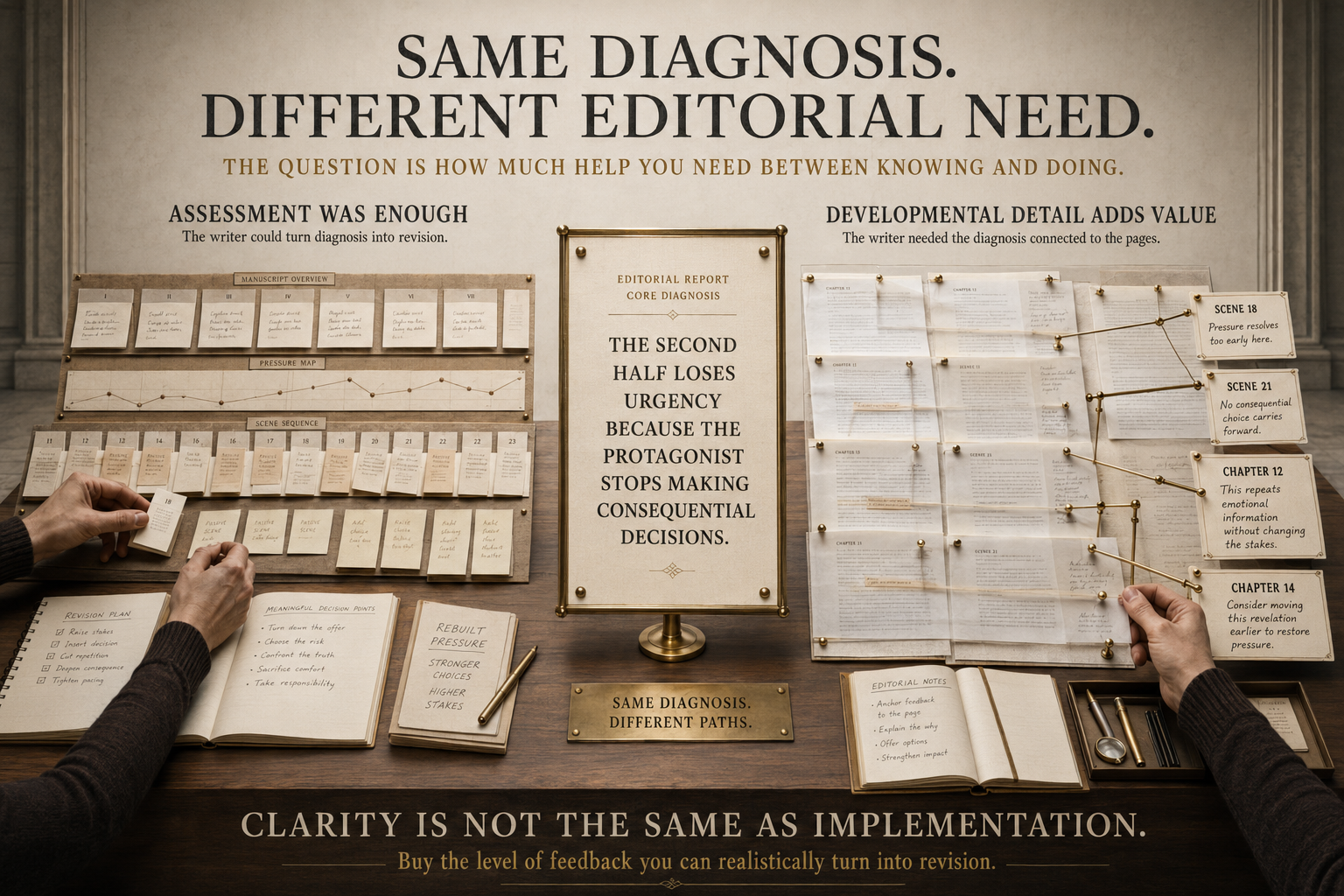
An experienced reviser might receive a strong assessment saying:
The second half loses urgency because the protagonist stops making consequential decisions.
That may be enough.
The writer can return to the manuscript, identify the passive scenes, rebuild the chain of decisions, and test the new version.
Another writer might read that exact same feedback and think:
I understand the criticism. I still have no idea which scenes need to change.
That writer may get much more value from developmental editing.
Same manuscript problem.
Different editorial need.
Use the Montlake First-Pay Test Before You Spend
Here is a simple way to make the decision without trying to diagnose your manuscript like an editor.
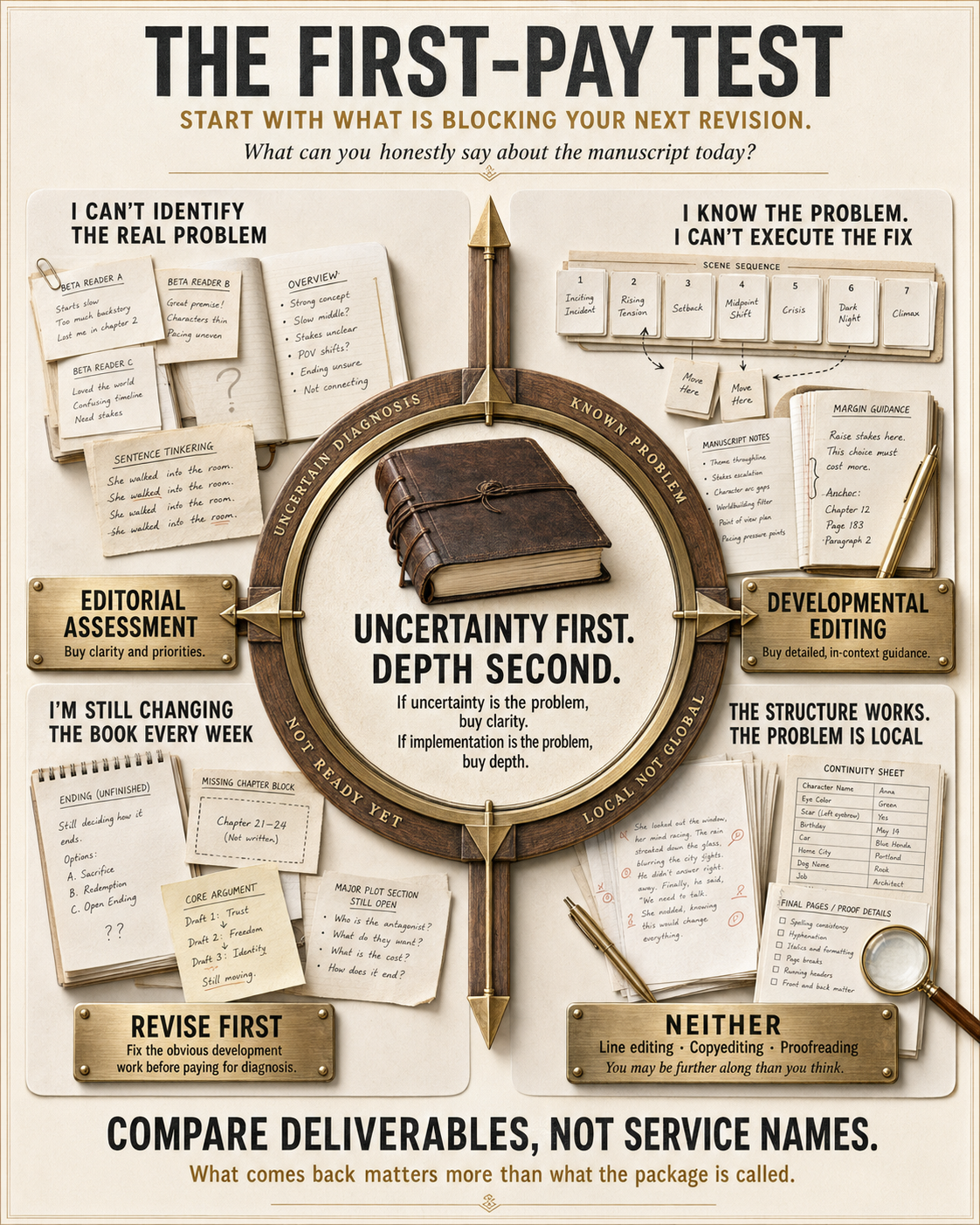
| What you can honestly say | Best first move | Why |
|---|---|---|
| “Something is not working, but I cannot identify the real problem.” | Editorial assessment | You need diagnosis and priorities before deeper intervention. |
| “Beta readers keep pointing to different symptoms.” | Editorial assessment | Professional analysis can look for the larger pattern behind conflicting feedback. |
| “I understand the main problems and can revise from clear direction.” | Editorial assessment | You may not need extensive comments throughout the manuscript. |
| “I know the book needs structural changes, but I cannot work out how to execute them.” | Developmental editing | You need detailed feedback tied to the manuscript. |
| “I need someone to show me where pacing, character, structure, or argument problems occur.” | Developmental editing | In-context guidance becomes more valuable than a high-level report. |
| “My structure is settled. I mainly need stronger sentences, grammar, consistency, or final cleanup.” | Neither | You may be ready for line editing, copyediting, or proofreading instead. |
| “Major plot points, chapters, or the ending are still changing every week.” | Keep revising first | You can still solve obvious development work before paying someone to identify it. |
That last row can save more money than any editing discount.
Professional editorial time should be spent on problems you cannot already solve yourself.
Should Most Authors Pay for an Editorial Assessment First?
Often, yes.
Always? No.
The source material behind this article strongly favors assessment as a useful starting point for writers who have not yet had a professional review. That makes sense because the assessment creates a roadmap without immediately committing the author to a more intensive service.
But turning that into “every author must buy an assessment before developmental editing” creates another problem.
It ignores the author.
If you have already revised extensively, received strong outside feedback, identified the structural weaknesses, and know that you struggle to convert broad criticism into concrete changes, paying for another high-level diagnosis may simply confirm what you already know.
In that situation, developmental editing can be the smarter first investment.
The rule should not be:
Assessment always comes first.
Use this instead:
Uncertainty first. Depth second.
If uncertainty is your biggest problem, buy clarity.
If implementation is your biggest problem, buy depth.
How Much Should Cost Influence the Decision?
Cost matters, but price alone should not choose the service.
Editorial assessments usually require less manuscript-level intervention than full developmental edits, so they commonly cost less.
For one current benchmark, the Editorial Freelancers Association's 2026 Rate Chart lists $600 as the median per-project figure for manuscript assessment/evaluation. That figure is a market reference, not a universal price and not a Montlake Publishers quote.
Your actual quote can change with manuscript length, genre, condition, complexity, turnaround, editor experience, and the work included.
This is why the cheaper service is not necessarily the better deal.
Paying less for an assessment does not help if you know you cannot turn high-level recommendations into a workable revision.
Paying more for developmental editing does not help if most of the editor's detailed comments identify problems you could have fixed before sending the manuscript.
Value comes from fit, not depth alone.
What Happens After an Editorial Assessment?
The report is not the finish line.
It is your revision brief.
Read the feedback once without immediately changing anything. Then read it again and look for patterns.
Separate recommendations into three groups:
Structural Priorities
These affect the whole book:
plot architecture
chapter order
central argument
character motivation
narrative focus
missing information
major pacing problems
Local Problems Caused by the Structure
These may appear in individual scenes or chapters but come from a larger issue.
For example, weak dialogue may actually come from a scene with no conflict. Repetitive paragraphs may exist because two chapters are trying to do the same job.
Later-Stage Issues
Sentence rhythm, punctuation, spelling, formatting, and final consistency usually matter more after the major revision is complete.
Work from largest to smallest.
Otherwise, you risk polishing language that your structural revision later removes.
What Happens After a Developmental Edit?
Expect to rewrite.
Developmental editing does not mean an editor quietly “fixes the manuscript” and sends back a publishable book.
You still make the creative decisions.
You may reject a suggestion because it changes the book you are trying to write. You may use the editor's diagnosis but choose a different solution. You may discover that one recommendation forces changes somewhere else.
That is normal.
Strong developmental editing gives you enough reasoning to make better decisions without taking ownership of those decisions away from you.
This is also where Montlake's emphasis on protecting author voice matters. Professional book editing services at Montlake Publishers are positioned around manuscript stage, reader experience, structure, language, and the kind of editorial intervention the book actually needs rather than treating every draft the same way.
When Should You Skip Both and Move to Another Type of Editing?
This part gets missed in many comparisons.
Sometimes the correct answer to editorial assessment vs developmental editing is:
Neither.
Suppose your beta readers follow the story easily. Character motivations make sense. The chapters are settled. You are no longer adding or removing major material. Your concerns now sound like:
“Some sentences feel clumsy.”
“My dialogue needs tightening.”
“I repeat certain words.”
“I need grammar and punctuation checked.”
“I want consistency before publication.”
“The formatted book needs one final error check.”
Those are later-stage problems.
Your manuscript may be ready for line editing, copyediting, or proofreading.
Buying another structural service simply because it sounds more comprehensive can waste both money and momentum.
Why Copyediting Too Early Can Become an Expensive Detour
Beautiful sentences cannot rescue a chapter the book does not need.
That is why structural questions normally deserve attention before sentence-level correction.
Your supplied source makes this distinction clearly: grammar, spelling, and sentence-level work matter, but they should not distract the author from larger problems while the manuscript is still structurally changing.
Think about what happens when the order is reversed.
You pay to clean the grammar in a scene.
Later, structural feedback shows that the scene repeats information from an earlier chapter.
You cut it.
The copyediting was technically good.
It was also spent on text that no longer exists.
Does the Best Choice Change for Fiction and Nonfiction?
The decision stays the same.
The questions change.
Fiction
Developmental feedback may examine:
plot
pacing
conflict
character arcs
motivation
point of view
scene purpose
stakes
continuity
opening and ending
genre expectations
Nonfiction
The editor may focus more heavily on:
central promise
organization
argument
chapter progression
evidence
repetition
gaps in explanation
reader knowledge
examples
clarity of purpose
whether the book delivers what its title or premise promises
Neither category automatically needs deeper editing.
Manuscript condition still decides the level of intervention.
What Should You Ask Before Paying an Editor?
Service names can hide very different scopes.
Before accepting a proposal, get clear answers to these questions.
What exactly will I receive?
Ask whether the service includes an editorial report, manuscript comments, tracked changes, chapter notes, or another deliverable.
Will you comment inside the manuscript?
This single question often reveals more than the package name.
How do you prioritize problems?
Useful structural feedback should help you distinguish a book-level problem from a minor local issue.
What happens after I receive the edit?
Find out whether clarification, a call, questions, or another review is included.
What does this service not cover?
Scope matters.
If grammar correction, line editing, fact-checking, formatting, or proofreading is outside the service, you should know before paying.
What will I still need to do?
Professional editing should never make the author's role mysterious.
You should know whether the next step involves rewriting, another editorial stage, or preparation for publication.
Common Mistakes That Waste an Author's Editing Budget
Buying the Deepest Service Because It Sounds Safer
More feedback is not automatically more useful feedback.
Buy what the manuscript can use now.
Asking an Assessment to Do a Developmental Edit's Job
If you already know you need detailed help reconstructing the manuscript, a broad report may leave you with the same implementation problem.
Asking Developmental Editing to Fix Grammar
Developmental editors may notice sentence-level problems, but structural editing has a different job.
Do not judge a developmental edit by how many commas it fixes.
Editing Before the Draft Is Ready for Outside Judgment
Finish the work you already know needs doing.
Do not pay someone to tell you the ending is unfinished when you already know the ending is unfinished.
Comparing Quotes Without Comparing Scope
Two prices mean very little until you know what each editor will deliver.
Compare the work, not just the total.
What Is the Best Editing Order After You Make This Decision?
No single sequence fits every manuscript, but the logic should stay consistent:
Fix the largest problem before the smallest one.
For one book, that may look like:
Editorial assessment → author revision → developmental editing → author revision → line or copyediting → proofreading.
For another:
Editorial assessment → major self-revision → copyediting → proofreading.
For another:
Developmental editing → substantial revision → line editing → copyediting → proofreading.
And for a structurally strong manuscript:
Copyediting → formatting → final proofreading may be enough.
The important thing is that every stage earns its place.
Once the manuscript is genuinely stable, book publishing services can make more sense because design, formatting, metadata, platform preparation, and production decisions no longer have to chase a manuscript that is still changing.
Final Thoughts: Pay for the Problem You Actually Have
The smartest answer to editorial assessment vs developmental editing is not “always choose the cheaper one” or “always choose the deeper one.”
Choose the service that closes the gap between where your manuscript is and what you can realistically do next.
Need someone to show you what is wrong and what deserves attention first?
Start with an editorial assessment.
Already understand the structural trouble but need detailed help working through it?
Developmental editing may be worth paying for first.
Know the structure works and only the language needs refinement?
Move forward. Do not buy another structural service because it sounds more professional.
Your manuscript does not need the most editing.
It needs the right editing at the right stage.
Not Sure Which Level of Editing Your Manuscript Actually Needs?
Do not choose an editing package by guessing from its name.
Bring the manuscript stage, genre, word count, previous revisions, publishing goal, and the problems you already see. Then decide what kind of editorial attention will actually move the book forward.
Review Montlake Publishers' professional book editing services and start with the question that matters most:
Frequently Asked Questions
Is an editorial assessment the same as developmental editing?
No. They overlap because both can examine big-picture issues such as structure, pacing, character development, organization, and reader experience. An editorial assessment usually emphasizes diagnosis and revision priorities, while developmental editing provides more detailed guidance tied to specific parts of the manuscript.
Should I get an editorial assessment before developmental editing?
Get an assessment first when you are unsure what the manuscript needs and feel confident revising from a professional roadmap. You can go directly to developmental editing when the structural problems are already apparent but you need detailed help deciding what to cut, move, expand, reorganize, or rethink.
Can I skip an editorial assessment and hire a developmental editor?
Yes. An editorial assessment is not a mandatory toll gate. If your draft has already been seriously revised and you know you need deeper structural help, commissioning another high-level assessment may duplicate work rather than move the manuscript forward.
Is a manuscript assessment the same as an editorial assessment?
Many editors use manuscript assessment, manuscript evaluation, manuscript critique, and editorial assessment for closely related big-picture review services. Definitions vary, which is why you should compare the promised deliverables instead of relying on the service title alone.
Does an editorial assessment include edits inside my manuscript?
Usually, the main deliverable is a written assessment rather than extensive editing throughout the manuscript. Some providers may include selected comments or examples. Confirm this before booking because scopes differ.
Does developmental editing include copyediting and proofreading?
Do not assume it does. Developmental editing focuses primarily on big-picture content and structure. Copyediting addresses detailed correctness and consistency, while proofreading belongs much closer to publication. Some editors combine services, but the proposal should state that clearly.
Which service is better for a first-time author?
Experience level alone should not decide. A first-time author who revises confidently from high-level feedback may get excellent value from an assessment. Another may need the specificity of developmental editing. Manuscript stage and revision ability matter more than whether this is your first book.
What if beta readers disagree about what is wrong?
Conflicting beta-reader feedback is one of the clearest situations where an editorial assessment can help. Instead of treating every reader comment as a separate problem, an editor can look for the manuscript-level cause behind several different reactions.
When is my manuscript ready for developmental editing?
Bring in developmental editing when the manuscript is complete enough to judge as a whole, you have already addressed the major problems you can identify yourself, and you are genuinely willing to make structural changes based on the feedback.
What should come after developmental editing?
Usually, you will revise the manuscript substantially before moving into sentence-level refinement or technical correction. Once the structure and content are stable, line editing or copyediting can become useful, followed by proofreading closer to publication.


