


Is Your Manuscript Ready for Editing? 9 Signs You May Be Paying Too Early
You type THE END, stare at the last page for a few seconds, and feel something between relief and panic.
Then the questions start.
Should an editor see it now? Should you revise it again? Is Chapter 7 actually working, or have you simply read it so many times that your brain has stopped objecting?
This is where authors can spend money at the wrong moment.
Put simply, a manuscript ready for editing is stable enough for the specific kind of edit you are paying for. It does not need to be flawless. But if you are still replacing chapters, changing the ending, rewriting the core argument, or fixing problems you already know are there, paying for sentence-level editing now may mean paying to polish pages you later delete.
Montlake Publishers takes the same stage-first approach. Its current editing process begins with the manuscript's genre, intended reader, word count, draft stage, previous revisions, and the problems the author already recognizes before deciding which editorial level fits.
Explore Montlake Publishers Book Editing Services
Key Takeaways
Ready does not mean perfect. It means ready for the next appropriate editorial job.
Structural problems should usually be settled before you spend money polishing sentences.
Fix the problems you can already identify before paying someone to identify them again.
Being too early for copyediting does not mean you are too early for every kind of professional help.
What Does “Ready for Editing” Actually Mean?
The answer depends on which edit you mean.
A developmental editor can work with a complete manuscript that still has problems with plot, pacing, character arcs, structure, argument, chapter order, or reader progression. Line and copyediting become more useful after those larger decisions settle. Proofreading belongs much later, when the main editing and formatting work is already complete.
That distinction matters financially, too.
The Editorial Freelancers Association released its 2026 Rate Chart in March after receiving more than 1,100 survey responses, its largest response count since the survey began in 1991. For fiction, its current median ranges include 3.0 to 3.5 cents per word for developmental editing, 2.0 to 2.7 cents for copyediting, and 1.2 to 2.0 cents for proofreading. These are industry reference figures, not Montlake pricing, and the EFA explicitly says individual fees vary by project and professional.
For an 80,000-word novel, paying for detailed correction before a major structural rewrite can become an expensive way to edit sentences that disappear later.
That is why timing matters.
9 Signs You May Be Paying for Editing Too Early
1. Important Parts of the Book Still Do Not Exist
Missing chapters count.
So do placeholder scenes, half-developed examples, research you still need to complete, and endings labelled in your notes as something like:
“Fix this later.”
There is nothing wrong with seeking professional help while a book is incomplete. The question is what kind of help.
A developmental consultation, manuscript assessment, or writing service can make sense before the full draft exists. Full copyediting usually does not.
Montlake's Book Writing service, for example, explicitly works with ideas, notes, recordings, research, memories, and unfinished chapters when the book still needs development rather than polishing.
2. You Are Still Changing What the Book Is Really About
This shows up differently in fiction and nonfiction.
For fiction, you may still be changing:
the central conflict
protagonist motivation
point of view
major relationships
story stakes
ending
For nonfiction, the moving pieces may be:
intended reader
central argument
chapter purpose
evidence
promise to the reader
order of ideas
If those decisions are still changing every few days, the manuscript is still being built.
You can edit the wording later. First decide what the words are supposed to accomplish.
3. Chapters Keep Moving, Merging, or Vanishing
Moving Chapter 4 after Chapter 11 once may be smart revision.
Moving it back three days later, splitting it in half on Friday, then wondering whether it belongs in the book at all on Sunday is a clue.
Editors Canada describes structural editing as work on the overall organization and content of material, including reorganizing, cutting, expanding, and reshaping text for its audience and purpose.
If you can already see major structural changes, complete as many of those as you reasonably can before paying for detailed sentence correction.
4. You Have Finished Writing, but Not Really Revised
Finishing the draft gives you material.
Revision turns that material into a book.
Those are different achievements.
Read once for structure rather than grammar. Ask whether every chapter earns its place. Look for repeated ideas, dropped threads, rushed transitions, weak scenes, unsupported claims, unnecessary explanation, and sections that exist because you enjoyed writing them rather than because the reader needs them.
You are not trying to replace an editor.
You are clearing away the problems that do not require one.
5. You Already Know What Is Wrong, but Have Not Fixed It
This is one of the simplest readiness tests.
You already know the opening takes too long.
You already know Chapter 8 repeats Chapter 5.
You already know one character disappears for 70 pages.
You already know the nonfiction example no longer supports the argument.
Do that work first.
Professional editorial judgment is most valuable when it reveals problems you cannot see clearly on your own.
Paying an editor to confirm every issue already sitting on your revision list is not the best use of the relationship.
6. Nobody Else Has Tested the Reading Experience
This does not mean every manuscript must go through beta readers before professional editing.
Sometimes editorial input should come first.
But when the manuscript is meant to be reasonably stable, outside readers can expose problems that familiarity has made invisible.
Ask readers questions that produce useful feedback:
Where did your attention drop?
Which part confused you?
What did you expect to happen next?
Which character decision felt unconvincing?
Which nonfiction section needed more explanation?
Where did the book repeat something you already understood?
Watch for patterns.
One reader wanting a different ending is an opinion.
Four readers losing track at the same chapter is information.
7. You Cannot Explain What You Want the Editor to Help With
“Make my book better” is understandable.
It is also a terrible project brief.
Compare it with:
“I need help identifying why the middle loses momentum.”
Or:
“The argument is complete, but I want the prose tightened before copyediting.”
Or:
“The story is settled. I now need grammar, punctuation, continuity, and consistency checked.”
Those requests describe different editorial jobs.
If you genuinely have no idea what the manuscript needs, that does not mean you should guess.
It may mean an editorial assessment is the logical first step.
Which Editorial Stage Fits the Manuscript You Have?
| What the manuscript looks like now | More appropriate next step | Probably premature |
|---|---|---|
| Important chapters or material still missing | Writing support or developmental guidance | Copyediting, proofreading |
| Full draft, but plot or structure remains unstable | Editorial assessment or developmental editing | Final proof |
| Structure settled, but prose feels awkward or uneven | Line or stylistic editing | Proofreading |
| Content settled, but technical errors remain | Copyediting | Publication without correction |
| Edited and formatted pages are nearly final | Proofreading | Major structural rewriting |
This is the central distinction:
Too early for one type of editing does not mean too early for professional help.
It means the help should match the stage.
8. Every Revision Still Rebuilds the Book
Healthy revision changes things.
Endless reinvention is different.
If every full read makes you switch narrators, replace the audience, rewrite the book's purpose, redesign the argument, or create a completely different ending, you may still be discovering the manuscript.
That is not failure.
Many books take shape that way.
It simply means the draft may need development rather than a late-stage edit.
An Illustrative Example
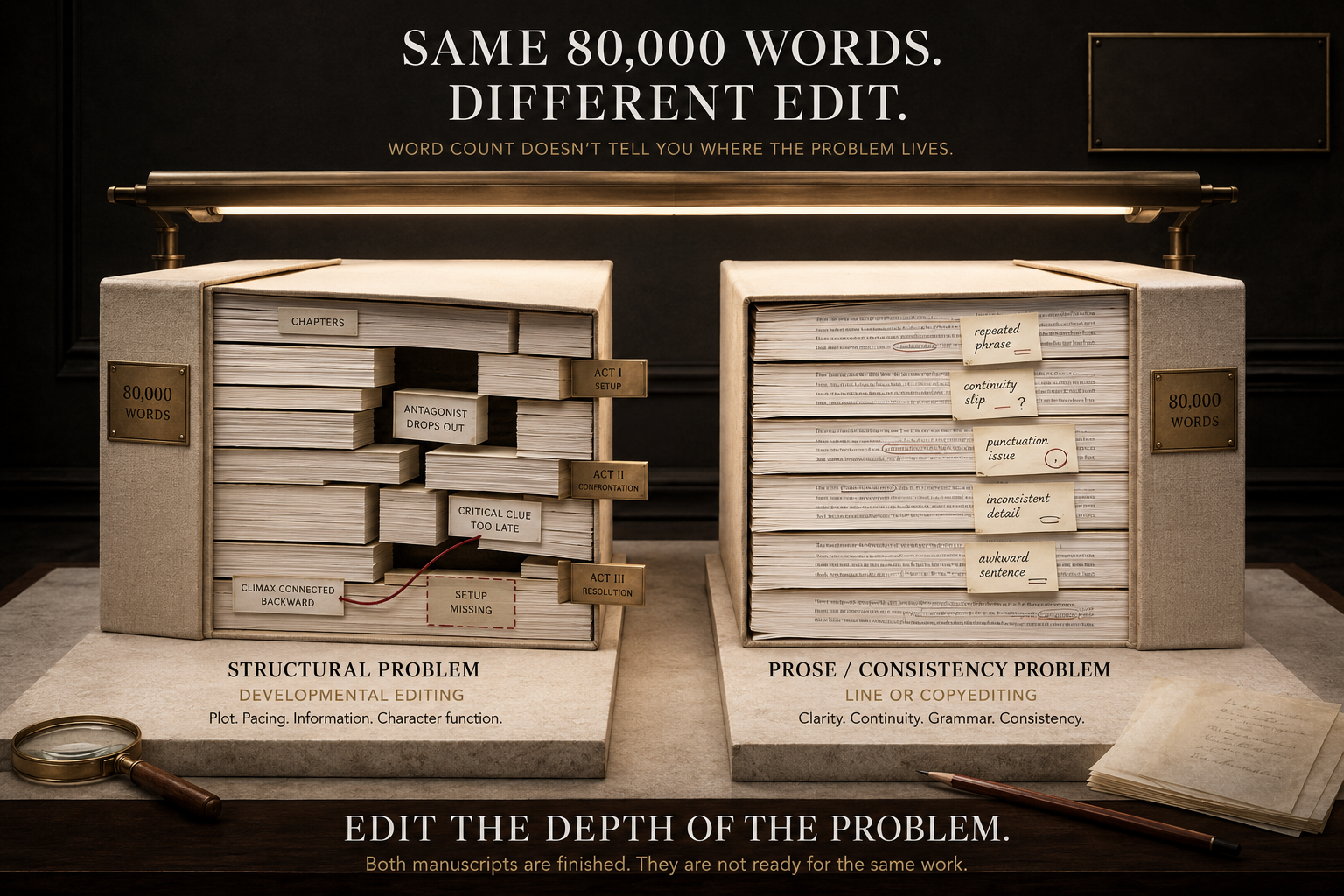
Picture two thriller writers with 80,000-word drafts.
The first writer has a complete story, but the antagonist vanishes through the middle, a key clue appears too late to feel fair, and the climax depends on information the reader never received.
That manuscript may be ready for developmental editing.
The second writer has already revised those structural issues. The plot is settled. Chapters are staying where they belong. The remaining problems are repetitive sentences, continuity slips, grammar, punctuation, and inconsistent details.
That manuscript may be ready for line or copyediting.
Both writers have “finished” a book.
They do not need the same edit.
9. You Are Hoping Proofreading Will Fix the Book
Proofreading is not a cheaper version of developmental editing.
It has a different job.
Editors Canada's current professional standards describe proofreading as a “separate, final editorial stage” and place it after textual and visual elements have been laid out.
A proofreader can catch things such as:
lingering typos
punctuation errors
spacing problems
inconsistent headers
layout errors
mistakes introduced during formatting or revision
Proofreading cannot rebuild a weak plot, repair an unclear thesis, supply missing evidence, deepen a flat character arc, or reorganize a confused book.
If the foundation still needs work, proofing is simply the wrong tool.
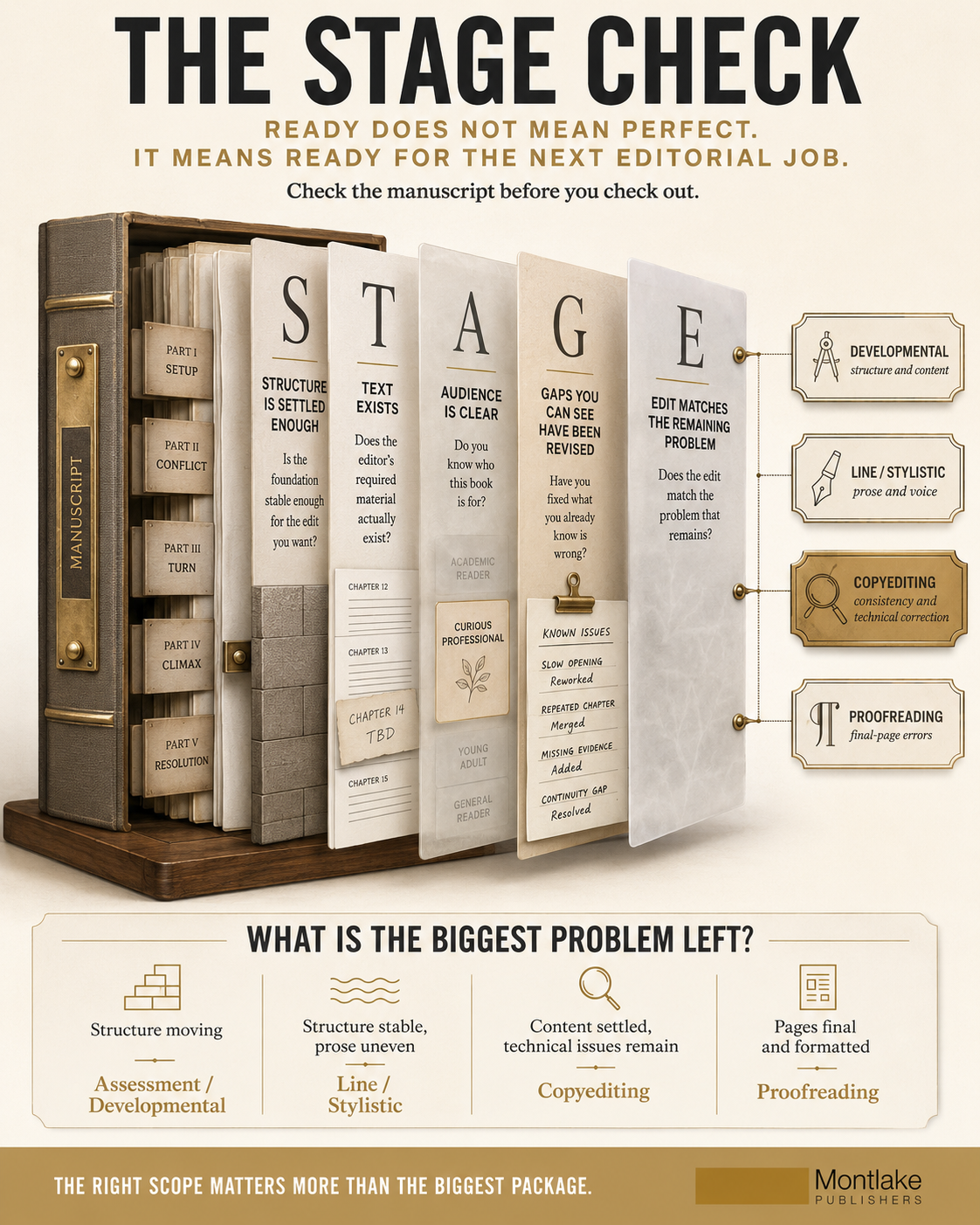
Use the STAGE Check Before You Pay for an Edit
Here is a more useful question than “Is my book finished?”
Run it through STAGE.
S: Structure Is Settled Enough
Your plot, argument, chapter sequence, reader journey, or narrative direction does not need to be perfect.
It should be developed enough for the editorial stage you are buying.
T: Text Exists
The material required for the editor's scope is actually there.
Full copyediting normally requires a reasonably complete manuscript. A developmental consultation may not.
A: Audience Is Clear
You should know who the book is written for.
A children's chapter book, business guide, memoir, literary novel, and romantic thriller make different promises to different readers.
Editors need that context.
G: Gaps You Can See Have Been Revised
Do not knowingly hand over obvious problems simply because an editor is coming.
Fix what you can.
Leave the editor the harder work.
E: Edit Matches the Remaining Problem
This is the most important gate.
If the problem is structure, buy structural help.
If the problem is prose, buy sentence-level help.
If the problem is technical consistency, investigate copyediting.
If the pages are final, consider proofreading.
Readiness is not about having nothing left to fix. It is about being ready for the right kind of fixing.
What Writers Often Get Wrong About Manuscript Readiness
Mistake 1: “Clean” Means Ready
Perfect commas do not tell you whether the middle of a novel works.
Technical cleanliness and structural readiness are different things.
Mistake 2: Waiting Until the Manuscript Feels Perfect
The opposite problem is just as common.
Some authors revise indefinitely because hiring an editor feels like admitting the manuscript has flaws.
It has flaws.
That is why editors exist.
You need to take the manuscript as far as you reasonably can, not prove you no longer need professional help.
Mistake 3: Choosing the Biggest Editing Package
More editing is not automatically better editing.
The right scope matters more.
Do this: identify the biggest unresolved problem and choose the editorial stage designed for it.
Not that: buy the deepest edit simply because it sounds more serious.
Montlake's current editing page follows this same logic. It states that the appropriate service depends on the manuscript's stage and its most important unresolved problem.
How to Prepare Your Manuscript Before Sending It
1. Freeze One Working Version
Stop making random edits across five files.
Choose the manuscript version you are preparing for editorial review, date it, and keep a clean backup.
2. Read for the Big Problems First
Ignore commas for a moment.
Check:
structure
plot or argument
chapter purpose
pacing
repetition
point of view
reader progression
missing information
Do not polish a paragraph you may cut tomorrow.
3. Complete a Separate Reader Pass
Ask what the reader knows, feels, expects, and needs at each stage.
Your knowledge of the book can hide gaps that are obvious to somebody encountering it for the first time.
4. Clear Your Known-Issue List
Keep a document called something simple, such as Problems I Already Know About.
Work through it.
Whatever remains after that becomes much more useful information for your editor.
5. Write a One-Page Editorial Brief
Include:
genre
intended reader
approximate word count
current draft stage
previous revision work
outside feedback already received
areas that concern you
questions you want answered
editorial outcome you are seeking
That gives the editor context before the first comment appears in the manuscript.
When Professional Help Makes Sense Even If the Draft Is Early
Sometimes waiting is the wrong advice.
Maybe you have rewritten the first third four times and still cannot diagnose why the story stalls.
Maybe your nonfiction book contains years of expertise but no clear architecture.
Maybe you have 50,000 words and realize you are writing toward three different readers.
Those are real reasons to ask for help.
The correct next step may be:
manuscript assessment
developmental consultation
structural editing
book coaching
writing support
rather than line editing or proofreading.
This is the point most “Is my manuscript ready?” articles miss.
Professional help is not one single event that happens after writing. Different professionals can solve different problems at different stages.
Where Montlake Publishers Fits
Montlake Publishers' current Book Editing process begins by looking at genre, intended reader, word count, draft stage, previous revisions, and the problems you already recognize. From there, the appropriate next step may be an editorial assessment, developmental edit, sentence-level edit, copyedit, final proof, or a planned sequence.
Review Montlake Publishers Book Editing Services
If the manuscript still needs substantial new material, interviews, research development, or missing chapters, writing support may make more sense first.
Explore Montlake Publishers Book Writing Services
Once the manuscript has completed its editorial work, publication preparation becomes a different stage involving files, formats, metadata, platform setup, and distribution decisions.
Explore Montlake Publishers Book Publishing Services
The goal is not to buy more publishing services.
It is to solve the next problem in the right order.
Final Thoughts
Sending a manuscript to an editor should feel a little uncomfortable. Someone else is about to see every shortcut, weak paragraph, plot wobble, repeated idea, and sentence you secretly hoped nobody would question.
That discomfort does not mean the manuscript is too early.
The stronger test is simpler: Have you taken the book as far as you reasonably can at its current stage, and do you know what kind of professional problem needs solving next?
A manuscript ready for editing still has work left in it. The difference is that the remaining work now deserves the editor's time more than another week of you rearranging the same sentences.
If you cannot tell which stage you have reached, diagnose the manuscript before you pay for the edit.
Not Sure Which Editing Stage Your Manuscript Has Reached?
You have already done the hardest part: getting enough of the book onto the page to ask a better question.
If you are unsure whether the remaining problem is structural, sentence-level, technical, or final-stage, review the manuscript stage before paying for the wrong edit. Montlake Publishers can help you identify which editorial direction fits the draft you actually have.
Review My Editing Options at Montlake Publishers
Frequently Asked Questions
How do I know if my manuscript is ready for a professional editor?
Your manuscript is ready when it is complete and stable enough for the kind of editing you need. Major story, structure, argument, or chapter changes point toward developmental work. Once those decisions are settled, line editing and copyediting become more useful. Final formatted pages are the right stage for proofreading.
Should I hire an editor for my first draft?
Usually, you should complete some meaningful self-revision before paying for detailed editing. An early draft can still benefit from developmental guidance, manuscript assessment, coaching, or writing support if you are stuck on direction or structure. The service should fit the problem rather than the label “first draft.”
How many revisions should I do before hiring an editor?
There is no correct number of revision rounds. Revise until you have addressed the substantial problems you can identify and the manuscript is stable enough for the editorial stage you want. One thoughtful structural revision may do more useful work than five passes spent changing individual sentences.
Do I need beta readers before professional editing?
No. Beta readers are useful for some manuscripts, but they are not a mandatory gate before hiring an editor. They can help reveal repeated points of confusion, pacing issues, emotional reactions, or reader expectations. Professional developmental feedback may also be appropriate before or instead of beta reading.
Should I choose developmental editing or copyediting first?
Developmental editing comes first when the manuscript still has substantial issues with structure, plot, pacing, character development, argument, organization, or reader progression. Copyediting is more appropriate after those larger decisions are stable and the remaining problems concern grammar, usage, continuity, consistency, and technical correctness.
Can an editorial assessment help if my draft is not ready?
Yes. An editorial assessment can be useful when you know the manuscript needs work but cannot identify the correct next stage. Rather than editing every sentence, the assessment can diagnose larger strengths and problems and give you a clearer revision direction before you commit to a deeper editorial service.
How much does book editing cost if my manuscript needs major work?
There is no single responsible price because cost changes with word count, genre, manuscript condition, editing level, editor experience, turnaround, and deliverables. The EFA's 2026 rate data shows substantial differences between developmental editing, copyediting, and proofreading, which is another reason to identify the correct scope first.
Can I send an unfinished manuscript to an editor?
Yes, if the professional service is designed for unfinished work. A manuscript assessment, developmental consultation, coaching arrangement, or writing service may work with partial material. Full copyediting usually becomes more useful once the text and structure are substantially settled.
Does Montlake Publishers review the manuscript stage before recommending an editing level?
Yes. Montlake's current Book Editing page states that genre, intended reader, word count, draft stage, previous revisions, and known problems are considered when identifying the next editorial step. The possible direction may include assessment, developmental editing, sentence-level work, or final proofreading.
What happens after professional editing?
It depends on the editing stage. Developmental feedback usually leads to author revision before later sentence-level work. Copyedited manuscripts can move toward formatting, while final formatted pages may then need proofreading. Publication preparation follows once the manuscript and production files are ready for that separate stage.


